NOAH'S
ARK WILDLIFE CENTRE
(Gobabis,
Namibia)
Noah's
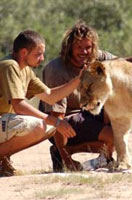
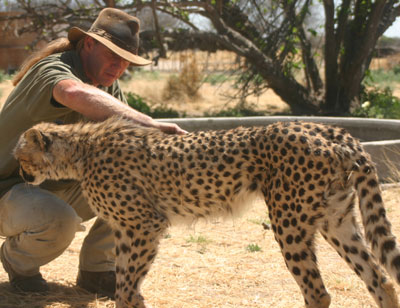
Ark gives volunteers the opportunity to care for and handle
African wildlife in the beautiful desertland of Namibia. The project is
located 250 kilometres east of Windhoek (close to Botswana border) in
the remote and stunning Omaheke Region which covers 4.9 million
hectares of farming land. Over the past 30 years, the
family-run Noah's Ark has been involved in the care, rehabilitation and
housing of orphaned, injured, neglected, abused and abandoned wild
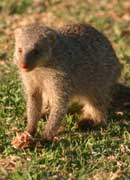
animals, including lion, leopard, cheetah, wild dog, meerkat, baboon,
many antelope species, etc.
Wildlife
are often considered "problem animals" in Namibia due to the
significant damage that they cause to livestock and agriculture and local
farmers often resort to shooting and trapping to eliminate the problem.
Noah's Ark works to educate local farmers, provide positive solutions to
the continuous problems between farmers and wild animals, and give
sanctuary to threatened wildlife. Additionally, Noah's Ark has
established a strong, trusting relationship with the local bushmen in the
surrounding areas (including the ability to speak their native language)
and uses this unique understanding of their ways and needs to help promote
conservation goals.
The project offers the chance to get some
real hands-on
experience helping many different species of Namibia's wildlife. Noah's
Ark operates a policy of never turning an animal away so if you want to
give ‘something back' during your stay in Namibia, this is an ideal
project with which to get involved.
Not
a week passes without a new occupant arriving, meaning you will have many
opportunities for hands-on work with animals!
Volunteer Work
As a volunteer at Noah's
Ark, you will primarily work with orphaned, injured, neglected, abused and
abandoned wild animals and help to create a stable environment for the
wildlife at the refuge. Along with caring for wildlife, you will help
perform reserve maintenance, assist the local field guides and learn how to
guide project tours.
Volunteer
duties at Noah's Ark include some of the following:
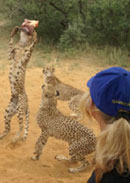
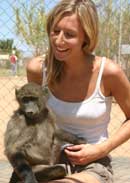
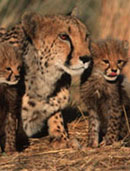
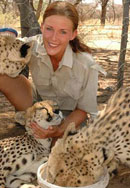
•Feeding cheetahs and baboons
(twice a day)
•Feeding
and meal preparation for other wildlife (4-5 times per day)
•Caring
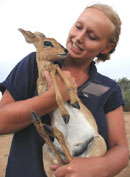
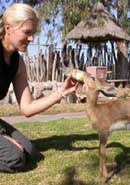
for, hand rearing and cleaning baby animals
•Night
duty of infant animals (surrogate parenting in bed)
•Cleaning
the enclosures
•Assisting
with repair and building of structures on the farm
•Building
wildlife camps
•Erecting
fences around Noah's Ark
•Assisting
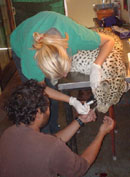
in the clinic with injured animals (qualified veterinary
experience required)
•
Training to assist as Field Guide for daily tours of Noah's Ark
•
Assisting at the local bushman clinic
Depending
on the time of year and demand, there is a possibility that you may also
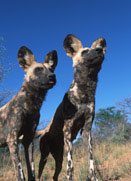
be able to assist with the African Wild Dog Project. This would involve
identifying individual wild dogs, looking at family patterns and recording
their eating habits.
Noah's
Ark relies significantly on volunteers so that its important work can
continue - you
will provide much needed help in caring for the ever-increasing number of
animals in the Centre. Please remember that everything you do,
however simple or mundane, helps the animals and the aims of the project.
Wildlife
at Noah's Ark
The
animals that have found their way to Noah's Ark can be divided into five
categories:
Problem
Animals -
Many animals cause significant damage to the local farmers and their
livelihood and as such pose a threat. Farmers thus resort to any means
possible to rid themselves of these problems. Noah’s Ark works to give
advice, collect caught animals and provide positive solutions to the
continuous problems between farmers and the wild animals of Namibia.
Injured
Animals -
Animals caught in traps and other devices are usually hurt beyond normal
recovery. Noah’s Ark is therefore unable to rehabilitate the animals,
but provides the necessary care to ensure they survive and live happily at
the sanctuary.
Pets
- The worst and
most commonly found problems arise from people that try to domesticate
wild animals and have them as house pets. This causes secondary problems
like the deliberate killing of female animals to get to her young. Not
being able to handle and understand these
grown
animals results in cruelty treatments when dealing with them. Noah’s Ark
thus acts as a haven for these unwanted pets, rescuing them from their
situations.
Orphaned
Baby Animals
-
Having been killed by hunters, poachers or road accidents, grown wild
animals leave orphans behind. The babies, sometimes as young as a day old,
are presented to Noah’s Ark for round the clock care and attention. As
adults these wild animals become "tame" and often enjoy the
company of people and so are unable to live elsewhere.
Animals
Born at Noah’s Ark
- Animals on the project are treated with hormone implants to prevent
pregnancies, but not all of them have been successful and as a result
animals have been born on the farm.
Ongoing
Research Projects
Noah's
Ark believes in life and takes its role very seriously in the conservation
and protection of Namibian wildlife, land and people. Noah's Ark
does everything possible to avoid resettled animals from being used for
hunting or commercial purposes. Presently, there are two on-going projects
coordinated by Noah's Ark :
• Wildlife
Rehabilitation and Reintroduction Project
• African Wild Dog Project
Rehabilitation
and Reintroduction Program - Noah's Ark has been rehabilitating injured, orphaned and problem animals for the past 25 years and has, in
this period, developed a perfect infrastructure for rehabilitation. The
project rehabilitates animals to their natural health, setting an international standard for
wildlife rehabilitation and care. Noah's Ark then releases those animals into
reserves, continuing to monitor and manage the released animals in the
reserve. The project is always seeking more release sites for fully
rehabilitated animals.
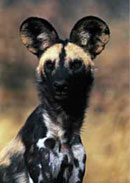
African
Wild Dog Project
--The
African Wild Dog is one of the most endangered predators in Africa. Wild
Dog populations have declined to such an extent in the past 30 years that
there are small populations left in only 14 countries where they were
previously present in 39. Only six of these countries have populations of
more than 100. The project recognizes the fact that the African Wild Dog
is one of Namibia's most valuable assets and intends releasing some of its
current captively-held dogs into a proposed 10,000 hectare reserve.
Age
Requirement
Noah's Ark accepts volunteers of 18+ years of
age. Volunteers under 18 years old are only considered when
accompanied by a parent/guardian. There isn't a maximum age limit,
though a reasonable fitness level is necessary.
Costs
Volunteer
Contribution:
2 weeks: GB£945 / US$1595
3 weeks: GB£1295 / US$2195
4 weeks: GB£1595 / US$2695
Extra weeks: GB£345 / US$595 per week
Please Note:
Volunteers receive a $100 discount when joining multiple Enkosini
programs.
Enkosini
uses USD rates as standard due to currency fluctuations. GBP rates
are indications of approx recent values. Currency convertor at
www.xe.com.
Volunteer contributions cover meals,
accommodation, sanctuary activities, transfers from Windhoek to Noah's Ark, and project
donation. Flights and travel/medical insurance are NOT included. The only
additional spending money required will be for personal purchases,
communication (phone/email), visa application fees, social
excursions away from Noah's Ark, and pre/post project travel. We do not have discounted rates for partial
weeks.
Please bear in mind that Noah's Ark is an extremely popular programme - the sooner you
apply, the better your chances of securing your placement!
Dates & Travel
Noah's Ark accepts volunteers all year
round. The program starts on Friday mornings and ends on Thursday
afternoons. The staff provide transfers from Windhoek to
Noah's Ark at 9:00am on Friday mornings for transfer to Noah's Ark before
lunch, therefore volunteers must fly into Windhoek the day before their
program start date and overnight at either Chameleon Backpackers (www.chameleonbackpackers.com) or Cardboard Box
Backpackers (www.ahj.addr.com).
These backpackers can arrange "meet and greet" pickups at the Windhoek Airport. The
staff return volunteers to Windhoek on Thursday afternoons after 2:00pm.
The closest
city to Noah's Ark is WINDHOEK. Flights are available from
Europe to Windhoek as well as from Johannesburg/Cape Town to
Windhoek. Great fares from Jo'Burg to Windhoek can be found at www.kulula.com.
Accommodation
& Meals
Your
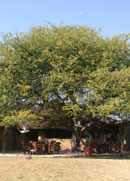
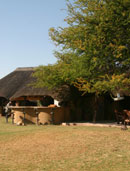
accommodation will be in the volunteer village - a clustering of raised
wooden cabins looking out onto a big waterhole. Each cabin sleeps
four volunteers and is occupied on a same sex basis. The cabins have only
two wooden sides. The other two sides are completely laid out with
mosquito netting, and the outside is covered by canvas which can be rolled
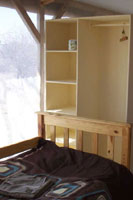
up and down. This provides a comfortable and cool area. Rooms
are fitted with individual storage areas for personal effects and single
beds with bedding and towels provided. The bathroom facilities are
shared, with hot water and flush toilets.
There is a separate kitchen and dining area, and three
meals a day are provided. Volunteers will prepare their own
breakfasts (cereal, tea, coffee, toast, fruit, yoghurt), but the other
meals will often be prepared by the Lodge. Please note that you may be
asked to assist with making sandwiches at lunchtime.
Training
/ Qualifications
Training will be provided by staff
at the project. A full introduction covering all aspects of working at
this project is given to volunteers upon arrival. Volunteers are then
allocated a supervisor, who will oversee the volunteers' daily work. A
manual is given to each volunteer which will include details of
responsibilities, policies and procedures of the farm, the
organizational structure, code of conduct and clear guidelines of all
aspects of working practices.
Age
Requirement
Noah's Ark is only accepting volunteers of
18-40 years. If you are over 40 years and had
your heart set on a hands-on experience with wildlife, we would highly
recommend the Namibia Wildlife Sanctuary, Moholoholo Wildlife
Rehabilitation Centre, Baboon Sanctuary or Vervet Monkey Sanctuary.
Work Visa
Requirement
The Namibian Department of Home Affairs
requires work visas for all volunteers of all nationalities joining the
Noah's Ark program. Noah's Ark has
engaged a company in Windhoek to process all work visa applications and
the application fee will be $99 USD. Please submit your visa
application with passport copy and document of independence 6 weeks before
arrival. Unless you have a work visa in hand, you must never mention
that you are volunteering at Noah's Ark - you may be denied entry as this
can be misconstrued by Immigration at working in the country.
Other
Noah’s
Ark is based in a remote area of Namibia (1½
hours drive from the nearest town)
and therefore volunteers will only be able to go into town on rare occasions. Communications
can be erratic and unreliable, most particularly email. There is
mobile reception in parts of the reserve and you will have access to phone
and fax. Volunteers must pay the local rate per minute for phone
usage.
Noah's
Ark is an ever-changing environment and power failures, water shortages,
temperature fluctuations and other uncontrollable situations do occur.
Volunteers need to remain flexible, understanding and in good humor/spirits about constant changes. “Africa time” can be very frustrating
for those who are used to a more structured way of life. You must be
tolerant and patient as things may not happen when you want or when it was
scheduled.
It
is very important when you come to Noah's Ark that you leave any
“romantic” ideas of life in the bush behind you. If you have
seen a documentary about the wonderful work, the animals, the landscape
and the family, it is easy to overlook the less glamorous side of the
project. Working at Noah's Ark is dirty and dusty. If you are
working with the animals, you are required to prepare their food. This
will mean cutting and handling fresh meat, etc. This may not be for
the squeamish! Also, please remember that certain
wildlife that you may not enjoy live at the Centre, including snakes, beetles, moths and
other “creepy-crawlies”. We do appreciate this can be a very
real difficulty for people and only you can decide whether it may spoil
the enjoyment of your trip or not.
Volunteers are required to sign an indemnity form acknowledging and
accepting the consequences of working in close contact with wild animals.
Testimonials
"Noah's Ark was one of the most amazing, life changing experiences I have
ever had! I spent a month at Noah's Ark working on rehabilitating and
taking care of wild animals. Never in my wildest dreams could I have
imagined being able to get so close to these animals. I had daily contact
with lions, cheetahs, meerkats, ostriches, baboons, vervet monkeys and so
much more.
By
the second day we were having hands on experiences feeding, cleaning and
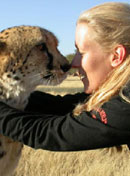
grooming the animals. I got to sleep with cheetahs (outside under the
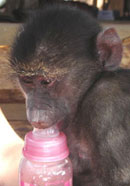
stars) and baby baboons (in my bed!). It is an unbelievable experience
being able to put a diaper on a baby baboon, feed it a bottle and have it
sleep in the bed with you. We experienced everything from hand feeding
cheetahs, to taking lions on walks and building a play area for the blind
vervet monkey. The daily schedule is pretty much the same but at any
moment something could happen - new animals arriving at the farm, an
animal needing attention, the bat eared foxes getting out of their
enclosure. You have to be on your toes because anything could happen...
the main motto is: expect the unexpected... and its true!
This
opportunity allowed me the chance to work with wild animals (one of my
passions) and also to look within myself. It was a once in a lifetime
experience that was the best choice I could have made!"
-Andrea Stein, United States
FAQs
Are
there telecommunication and medical facilities at the project?
There
is a telephone/fax facility in the office that may be used for phone
calls. This will print out all calls made and calls will be charged to
volunteer accounts. There is a phone booth on the premises and phone
cards can be purchased in the office. The nearest clinic is 10 minutes
away and the nearest hospital is an hour and
a half away, but the project itself does keep a good supply of medicine
for minor injuries, ailments, etc.
How
much do the volunteers work? Is there any free time?
Animals
need constant care and attention. There is no time off from the daily
routine. The volunteers generally work about 6-8 hours during the
week, and several hours per day on the weekends to feed the animals (once
feedings are done, you have the rest of the day off).
It
is recognized that you will need some time to relax and rest. You will be
allocated some time each day to chill out with other volunteers, sit by
the pool or just relax around the farm. Please understand that you
must remain flexible about when and for how long this will be depending on
the animals' needs. If possible, we will try to take you on various
trips or have a fun activity once a week.
What
kind of clothes should I bring?
Always
wear clothes that are dispensable. You will be working with meat, blood,
animal food, dirt and dust etc. Always wear closed shoes when you are
around the animals. Avoid wearing dangling objects, loose clothes or
jewelry, especially rings, around the animals. Be careful of wearing hats
or sunglasses when working with animals, as some may feel threatened by
these. You must also wear your nametag and project shirt. These will be
provided by your manager.
What
should I know about general safety and security?
The
office has a safe for important documents or expensive items. It is always
sensible to lock your sleeping quarters and keep windows closed when you
are not there. Very occasionally, animals such as young baboons can
escape. Always be aware and keep alert as you move around Noah's Ark.
If you see anything that looks out of place or a possible source of
danger, report it as soon as possible. Some of the game and animals in the
open areas can be aggressive. Be careful when approaching any of
the animals.
What
is the climate like in Namibia?
Namibia
has a harsh climate. It is generally very hot, however in the winter
months (from May to August) the temperatures can drop dramatically in the
evenings. Do not underestimate how cold it is in the winter months!
There is a rainy season from February to April.
What
should I bring?
Town
trips are infrequent so it is important to bring enough of the necessities
for the duration of your stay (smokers should certainly stock up ahead of
time!).
We
suggest the following packing list:
•
A "willing to learn and participate" attitude
• A sleeping bag and pillow
• Natural color clothing and hat
• Comfortable walking shoes/boots
• Raincoat
• Thick socks
•
Alarm clock/watch
•
Books, paper and pens
• Camera, film and batteries
• Adaptor
• Biodegradable detergent and washing line
•
Working gloves
• Day sack
• Personal toiletries (soap, shampoo, deodorant, feminine products)
•
Small first-aid kit (prescribed medication, plasters, disinfectant
wipes, painkillers, after-bite product, anti-mosquito products,
tooth repair kit, rehydration salts, Imodium)
• Insect repellent
• Powerful flashlight/torch
• Sunblock and sunglasses
• Passport, Visas and Medical/Travel Insurance documents
The
Story of Noah's Ark
Over
the past 30 years, Noah’s Ark has been involved in the care,
rehabilitation and housing of orphaned, neglected, abused and abandoned
wild animals. On 19th January 2001, the family’s beloved father and
husband died of a sudden illness. His wife, their children and their
spouses have since been intimately involved with the managing and
development of this project.
Recent
publicity given to Noah’s Ark has resulted in such an enormous escalation
of received animals that the initial "hobby" has now
changed into a full-time occupation for nearly 60 local people. The
project is fully dedicated to preserving the animals and supplying them
with their natural habitat in a large reserve area. At first, the family
used their own earnings to carry the project expenses, but due to a
dramatic increase in both the number of rescued animals and the running
costs of the wildlife foundation, the need for a wildlife trust fund was
born. Having never received any government funds or grants, the family has
still managed to win international acclaim for their success in rescuing
and caring for the Namibian wildlife. The project is now a registered
animal welfare organisation.
Noah’s
Ark believes in life and takes its role in conservation and the protection
of the Namibian
wildlife, land and people very seriously. It should be remembered that
this project would not be necessary if people left the wild animals
alone in their natural habitat. From hunting, poaching and the buying and selling of wild animals, it is becoming increasingly hard to prevent or
improve on the given situation. Without the help of places like
Noah’s Ark, the eventual extinction of wild animals in Africa will be
difficult to prevent.
In principle, Noah’s Ark
is against the confinement of wild animals, however there are times when
this is inevitable. When released into the wild, there is a very high
mortality rate in previously captive animals. There is also a shortage of
safe and hospitable release sites for large carnivores and all wild animal
species in Namibia. It takes a great deal of manpower, effort and money to
successfully monitor a newly released animal and ensure its survival.
The
project provides animals that have nowhere else to go with the opportunity
to live in semi wild, safe, roaming areas. This is the safest place for
those animals that cannot be successfully released. Noah’s Ark does
everything possible to avoid resettled animals from being used for hunting
or commercial purposes.
Noah’s
Ark also has a clear policy of employing people from the local community
for as many jobs as possible, hereby supporting the social and economic
growth of the community and the sense of conservation it creates among the
local people.